Death of a Naturalist
Seamus Heaney's 'Death of a Naturalist' is a vivid, sensory exploration of childhood wonder transforming into fear. It offers a powerful, dramatic volta and rich natural imagery, making it an incredibly rewarding poem to analyse for structural and linguistic effects in the exam.
Study Notes
Overview
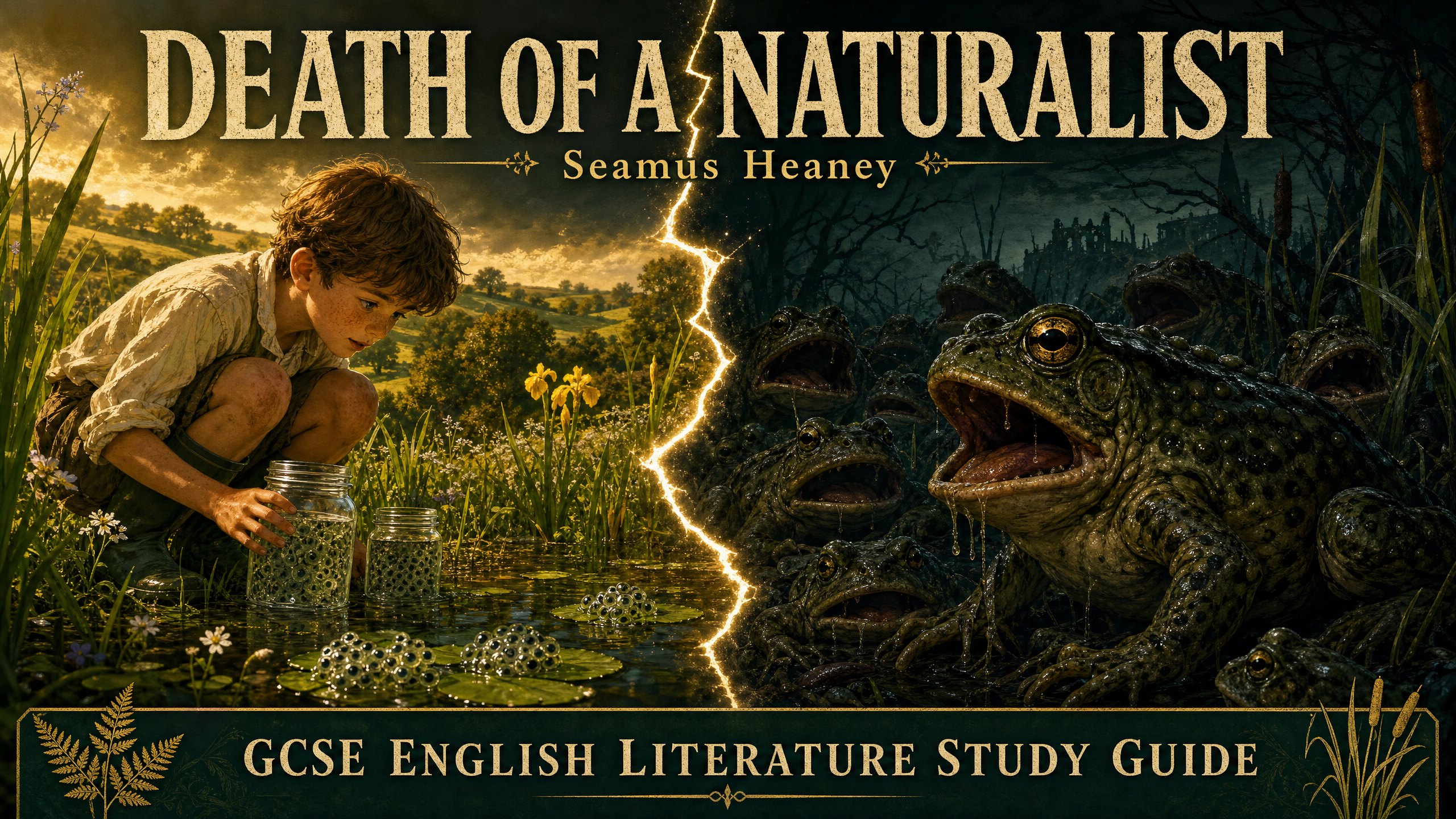
'Death of a Naturalist' (1966) is the title poem of Seamus Heaney's debut collection. It vividly captures a childhood memory of collecting frogspawn from a flax dam in rural Northern Ireland. The poem is a quintessential 'coming-of-age' text, charting the speaker's abrupt transition from innocent, childlike fascination with nature to a visceral, overwhelming fear of it. Examiners reward candidates who can confidently analyse the dramatic structural shift (the volta) between the two stanzas, and who can unpick how Heaney's sensory language evolves from playful and curious to aggressive and threatening.
Listen to our 10-minute revision podcast to cement your understanding:
Plot/Content Overview
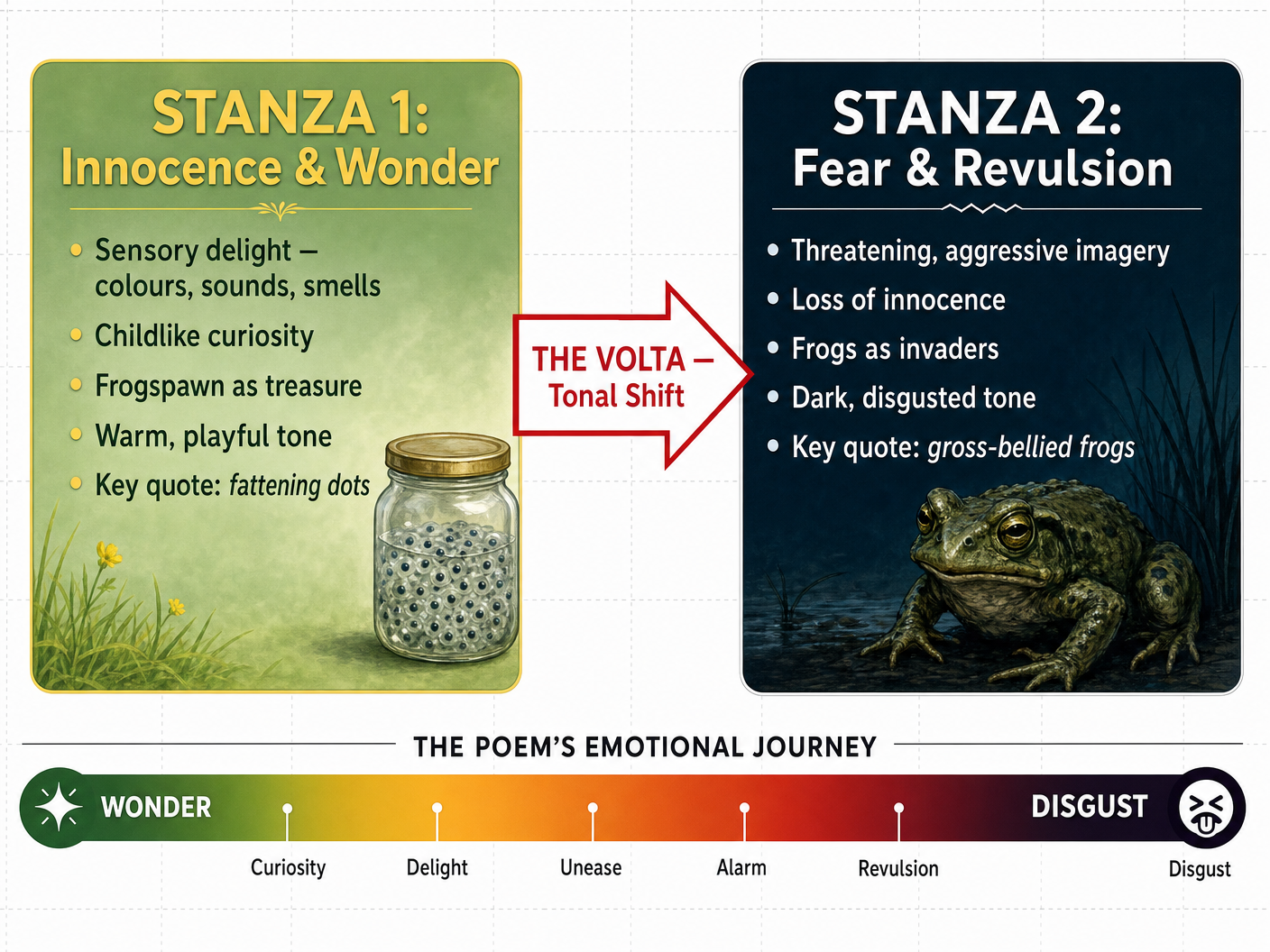
Stanza 1: The speaker fondly recalls visiting a local flax dam as a child, surrounded by the sights, sounds, and smells of nature. He describes the joy of collecting frogspawn in jam jars and watching it develop into tadpoles, guided by the simplified, comforting explanations of his teacher, Miss Walls.
Stanza 2: The tone shifts abruptly ('Then one hot day'). The speaker returns to the dam to find it overrun by hundreds of aggressive, loud frogs. Terrified and repulsed by their 'gross-bellied' appearance and 'coarse croaking', the child flees, feeling that nature is taking 'vengeance' and that his innocent relationship with the natural world is dead.
Themes
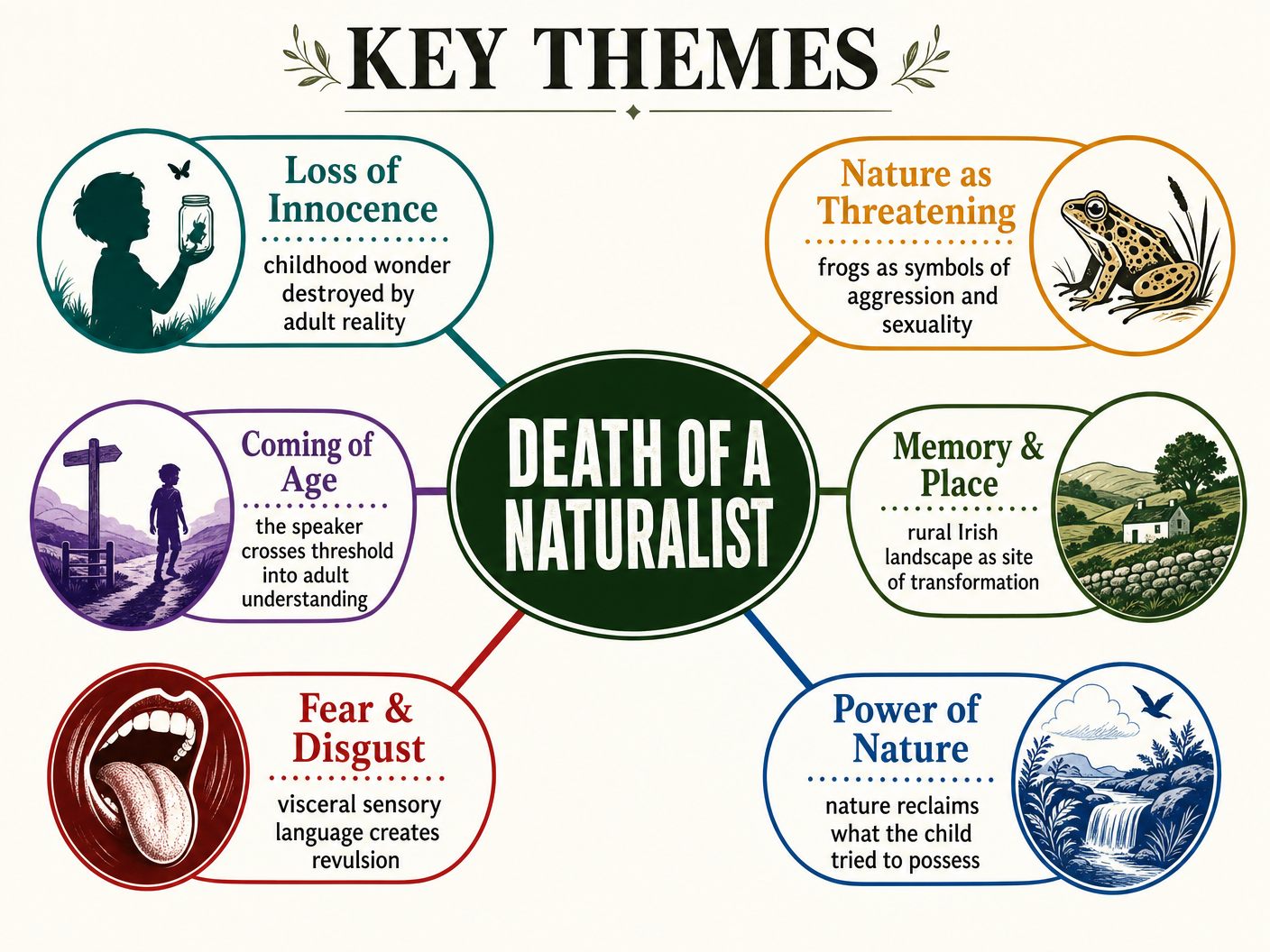
Theme 1: Loss of Innocence and Coming of Age
The poem fundamentally explores the threshold between childhood and adulthood. The child's initial naive view of nature, shaped by his teacher's safe explanations ('the daddy frog'), is violently shattered by the raw, uncontrolled reality of the frogs' mating season.
Key Quotes:
- "Miss Walls would tell us how / The daddy frog was called a bullfrog" (Stanza 1) - The infantilising language highlights the speaker's initial, protected innocence.
- "I sickened, turned, and ran." (Stanza 2) - The physical reaction marks the definitive end of his childhood curiosity.
Theme 2: Nature as Threatening and Powerful
While stanza one presents nature as a playground and a source of treasure, stanza two reveals its intimidating power. Nature is not passive; it is an active, aggressive force that reclaims what the child tried to possess.
Key Quotes:
- "The great slime kings / Were gathered there for vengeance" (Stanza 2) - The metaphor elevates the frogs to powerful, threatening rulers punishing the child's intrusion.
- "I knew / That if I dipped my hand the spawn would clutch it." (Stanza 2) - The personification of the spawn shows the speaker's new-found terror of nature's possessive power.
Writer's Methods
Structure (The Volta):
The poem's two-stanza structure perfectly mirrors the thematic shift. Stanza one (21 lines) is expansive and enthusiastic. The volta at line 22 ('Then one hot day') abruptly breaks this mood. Stanza two (12 lines) is dense, dark, and panicked. Examiners highly reward analysis of how this structural division creates tension and reflects the sudden loss of innocence.
Sensory Language and Onomatopoeia:
Heaney's use of sound is masterful. In stanza one, the sounds are lighter ('clucking', 'slobber'). In stanza two, the sounds become heavy, plosive, and threatening ('coarse croaking', 'bass chorus', 'slap and plop'). The harsh 'c' and 'p' sounds mimic the physical reality of the frogs, creating a visceral sense of disgust.
Imagery and Metaphor:
The transformation of the frogspawn from 'fattening dots' (curious, developing) to 'gross-bellied frogs' (repulsive, adult) drives the poem. The military/royal imagery in stanza two ('mud grenades', 'slime kings') frames the frogs as an invading army, completely overpowering the vulnerable child.
Context
Seamus Heaney (1939-2013) grew up on a farm in County Derry, Northern Ireland. His early poetry is deeply rooted in the rural landscape of his childhood, characterized by its earthy, physical reality. The poem can be seen in the tradition of Romantic nature poetry (like Wordsworth's 'The Prelude'), which often focuses on childhood encounters with the sublime or terrifying aspects of nature as formative experiences. Understanding this helps explain the speaker's profound psychological shift.
Visual Resources
2 diagrams and illustrations
Interactive Diagrams
1 interactive diagram to visualise key concepts
Conceptual Flow Outline
The structural and thematic progression in 'Death of a Naturalist'
Worked Examples
1 detailed example with solutions and examiner commentary
Practice Questions
Test your understanding — click to reveal model answers
How does Heaney use language to create a sense of threat in the second stanza of 'Death of a Naturalist'?
Hint: Focus on the sensory imagery (especially sound) and the metaphors used to describe the frogs.